
The square root, a fundamental concept in mathematics, unlocks a world of problem-solving possibilities, from calculating the dimensions of a perfect square to understanding the intricacies of irrational numbers. This exploration into how to find square roots goes beyond mere calculation; it’s a journey into the heart of mathematical principles, revealing the elegance and practicality of this often-overlooked operation.
We’ll traverse various methods, from the foundational understanding of square roots and prime factorization to the more advanced long division method and estimation techniques. Each step will be meticulously detailed, providing clear examples and visual aids to ensure comprehension. We’ll also delve into the use of calculators and real-world applications, showcasing the pervasive influence of square roots across disciplines. Finally, we’ll explore the fascinating realm of irrational numbers, further expanding our mathematical horizons.
Understanding the Fundamental Concept of Square Roots is Essential for Mathematical Proficiency
The concept of square roots is a cornerstone of mathematics, forming the basis for understanding more advanced concepts and providing the tools to solve a wide range of problems. Mastery of square roots is crucial not only for academic success but also for practical applications in various fields, from engineering and physics to finance and computer science. A solid grasp of this fundamental concept is, therefore, essential for developing mathematical proficiency.
Defining the Square Root
The square root of a number is a value that, when multiplied by itself, gives the original number. This operation is the inverse of squaring a number. Squaring a number involves multiplying the number by itself, while finding the square root involves determining what number, when multiplied by itself, results in the given number. This relationship is fundamental to understanding the nature of square roots.
If x² = y, then √y = x.
This definition highlights the reciprocal relationship between squaring and taking the square root. For example, the square root of 9 is 3 because 3 multiplied by itself (3 * 3) equals 9. It’s important to note that every positive number has two square roots: a positive and a negative one. For instance, both 3 and -3, when squared, result in 9. The square root symbol, “√”, denotes the principal (non-negative) square root. This convention is essential for consistent mathematical calculations.
The applications of square roots are widespread. In geometry, they are used to calculate the side lengths of squares given their area, or to find the lengths of the sides of right-angled triangles using the Pythagorean theorem. In physics, square roots appear in formulas related to motion, energy, and waves. For instance, the velocity of an object falling under gravity is related to the square root of the distance it has fallen. In finance, square roots can be used in calculating compound interest and analyzing investment returns. In computer science, square roots are used in algorithms for image processing, data compression, and cryptography.
Illustrative Examples of Square Roots
Finding the square root of perfect squares provides a clear understanding of the concept. Perfect squares are numbers that result from squaring an integer. Here are several examples:
- The square root of 25 is 5, because 5 * 5 = 25. The positive square root is often written as √25 = 5. The negative square root is -5, because (-5) * (-5) = 25.
- The square root of 16 is 4, because 4 * 4 = 16. The positive square root is written as √16 = 4. The negative square root is -4, because (-4) * (-4) = 16.
- The square root of 100 is 10, because 10 * 10 = 100. The principal square root is √100 = 10. The negative square root is -10, because (-10) * (-10) = 100.
- Consider the number 0. The square root of 0 is 0, because 0 * 0 = 0.
Visual representation can enhance understanding. Imagine a square with an area of 9 square units. The side length of this square is the square root of 9, which is 3 units. Similarly, a square with an area of 16 square units has sides of length 4 units. This visual representation helps to connect the abstract concept of square roots with a tangible geometric form. A number line can also be used. For instance, on a number line, the square root of 4 is represented by the points +2 and -2, each the same distance from the origin (0).
The Significance of Principal Square Roots
The principal square root is the non-negative square root of a number. It is denoted by the radical symbol “√” without any other indicator. Understanding the principal square root is critical because it ensures consistency in mathematical calculations and avoids ambiguity.
- When solving equations involving square roots, it is crucial to consider both the positive and negative roots. For example, if x² = 9, then x = ±3. However, when the square root symbol is used alone, it represents the principal square root. Therefore, √9 = 3.
- In practical applications, the principal square root is often used because it provides a meaningful answer in the context of the problem. For example, when calculating the length of a side of a square, the negative square root is not relevant. The length cannot be negative.
- The principal square root plays a crucial role in complex number theory. The square root of a negative number is defined using the imaginary unit ‘i’, where i = √-1. The principal square root concept helps to maintain consistency in operations with complex numbers.
Understanding the distinction between the principal square root and both the positive and negative roots is essential for accurate calculations and interpretations. Ignoring the principal square root can lead to errors and misunderstandings in various mathematical contexts.
Exploring the Method of Prime Factorization to Determine Square Roots is a Valuable Skill
The prime factorization method offers a systematic approach to finding the square root of a number, particularly useful for understanding the fundamental structure of numbers and simplifying calculations. This technique breaks down a number into its prime factors, revealing the building blocks that constitute it, and allowing for a straightforward determination of its square root. Understanding and applying this method is crucial for building a strong foundation in mathematics and can be applied in various fields, from basic arithmetic to advanced algebraic concepts.
Step-by-Step Procedure for Prime Factorization
Prime factorization involves expressing a number as a product of its prime factors. This method is effective because the square root of a number can be easily derived once its prime factors are known.
Here’s a detailed step-by-step procedure:
- Start with the Number: Begin with the number whose square root you want to find.
- Divide by the Smallest Prime Number: Divide the number by the smallest prime number (2, 3, 5, 7, 11, and so on) that divides it evenly.
- Record the Prime Factor: Write down the prime number you divided by.
- Repeat the Division: Divide the result of the previous division by the same prime number, if possible. Continue until it is no longer divisible by that prime.
- Move to the Next Prime Number: If the number is no longer divisible by the previous prime, move to the next prime number and repeat the division process.
- Continue the Process: Continue dividing by prime numbers and recording them until you reach a quotient of 1.
- Express as a Product: Express the original number as the product of all the prime factors you found.
- Pair the Factors: Group the prime factors into pairs. A perfect square will have all its prime factors paired.
- Calculate the Square Root: For each pair of prime factors, take one factor out of the square root. Multiply these factors together to find the square root of the original number. If there are any prime factors that do not have a pair, the original number is not a perfect square, and the square root will be irrational.
Solved Examples Using Prime Factorization
The prime factorization method allows for easy identification of perfect squares and simplifies the process of finding square roots. Here are examples showcasing the method for both perfect squares and numbers that are not perfect squares.
- Example 1: Finding the square root of 144 (Perfect Square)
- Prime Factorization: 144 = 2 x 2 x 2 x 2 x 3 x 3
- Pairing: (2 x 2) x (2 x 2) x (3 x 3)
- Square Root: √144 = 2 x 2 x 3 = 12
Therefore, the square root of 144 is 12.
- Example 2: Finding the square root of 121 (Perfect Square)
- Prime Factorization: 121 = 11 x 11
- Pairing: (11 x 11)
- Square Root: √121 = 11
The square root of 121 is 11.
- Example 3: Finding the square root of 45 (Not a Perfect Square)
- Prime Factorization: 45 = 3 x 3 x 5
- Pairing: (3 x 3) x 5
- Square Root: √45 = 3√5
Since 5 does not have a pair, the square root of 45 is 3√5, an irrational number.
- Example 4: Finding the square root of 200 (Not a Perfect Square)
- Prime Factorization: 200 = 2 x 2 x 2 x 5 x 5
- Pairing: (2 x 2) x 2 x (5 x 5)
- Square Root: √200 = 2 x 5√2 = 10√2
The square root of 200 is 10√2, an irrational number.
Visual Aid: Prime Factorization Diagram
A visual aid, such as a factor tree diagram, simplifies the prime factorization process, making it more accessible.
Imagine a tree, with the original number at the top as the trunk. Branches split off, representing divisions by prime factors. At the end of each branch, you have the prime factors. The process continues until all branches end with prime numbers. For instance, to find the prime factors of 36, you would start with 36 at the top.
The diagram would look something like this:
| 36 |
| / \ |
| 2 18 |
| / \ |
| 2 9 |
| / \ |
| 3 3 |
This factor tree clearly shows that 36 = 2 x 2 x 3 x 3. Pairing these factors, we get (2 x 2) x (3 x 3). The square root of 36 is 2 x 3 = 6. The diagram visually breaks down the number, making it easier to identify the prime factors and their pairs. The simplicity of this visual aid makes it easier for students to grasp the concept of prime factorization. It highlights the fundamental building blocks of the number and simplifies the process of finding the square root. The visual structure helps to organize the information, making it more manageable and intuitive. This diagram helps to clarify the concept, especially for visual learners, transforming an abstract concept into an easily understandable process.
The Long Division Method Presents an Alternative Approach to Calculating Square Roots
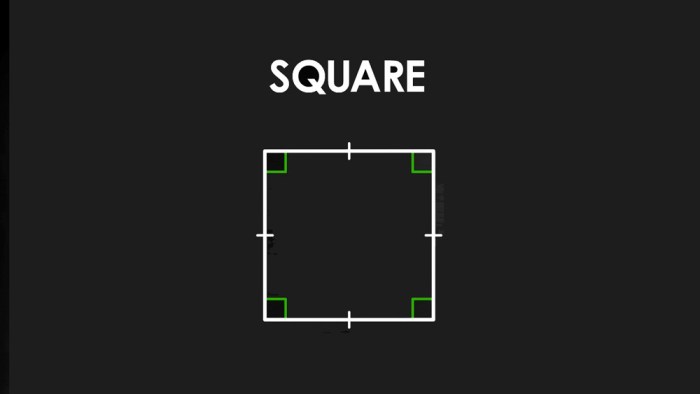
The long division method provides a systematic, algorithmic approach to determine the square root of a number. While potentially more involved than prime factorization, it offers the advantage of working directly with the number without requiring prior knowledge of its prime factors. This makes it particularly useful for numbers that are not easily factorized or when a quick estimation is needed.
The Long Division Method: Procedure and Application
The long division method for finding square roots involves a series of steps that systematically narrow down the estimate of the square root. It’s an iterative process, refining the approximation with each stage.
Here’s a breakdown of the procedure:
1. Grouping the Digits: Starting from the decimal point (or the units digit if there is no decimal), group the digits in pairs, moving left and right. For example, the number 1234.56 would be grouped as 12 34. 56. If there’s an odd number of digits to the left of the decimal, the leftmost digit stands alone (e.g., in 345, the grouping would be 3 45). If there is an odd number of digits to the right of the decimal, add a zero to make a pair (e.g., 1.2 becomes 1.20).
2. Finding the First Digit of the Square Root: Find the largest whole number whose square is less than or equal to the leftmost group. This number becomes the first digit of the square root. Write this digit above the corresponding group.
3. Subtracting and Bringing Down: Subtract the square of the first digit from the leftmost group. Bring down the next group of digits to the right of the remainder.
4. Forming the Divisor: Double the quotient (the part of the square root you’ve calculated so far) and write it to the left of the new dividend (the number you just brought down). This doubled value forms the beginning of your next divisor.
5. Finding the Next Digit of the Square Root: Determine the largest digit (let’s call it ‘x’) that, when placed next to the doubled quotient and multiplied by itself (e.g., (doubled quotient * 10 + x) * x), is less than or equal to the current dividend. Write this digit ‘x’ above the next group of digits in the square root.
6. Subtracting and Repeating: Subtract the result of the multiplication from the current dividend. Bring down the next group of digits. Repeat steps 4 and 5 until all groups have been used or the desired level of precision is achieved.
This process continues, refining the approximation of the square root with each iteration. The long division method, while seemingly complex at first glance, provides a robust and reliable way to calculate square roots, especially when calculators are unavailable or when understanding the underlying mathematical process is crucial. The method hinges on the algebraic expansion of a perfect square:
(a + b)^2 = a^2 + 2ab + b^2
Each step essentially isolates and solves for ‘b’ in this expansion, iteratively refining the approximation of the square root. The repeated subtraction and division are a practical application of this fundamental algebraic concept.
Comparison of the Long Division and Prime Factorization Methods
Both the long division method and prime factorization offer ways to determine square roots, but they differ in their approach and suitability depending on the number.
Here’s a comparison:
| Feature | Long Division Method | Prime Factorization Method |
|---|---|---|
| Approach | Algorithmic, iterative, uses repeated subtraction and division. | Decomposes the number into its prime factors. |
| Advantages | Works for any number; does not require prior knowledge of factors; handles decimal numbers easily. | Simpler for numbers with easily identifiable prime factors; provides insight into the number’s composition. |
| Disadvantages | Can be time-consuming and prone to errors, particularly for large numbers; requires meticulous calculations. | Inefficient for numbers with large prime factors; not applicable if the number is not a perfect square (without modifications). |
| Best Suited For | General purpose; numbers where prime factorization is difficult; situations where a calculator is unavailable. | Numbers with readily identifiable prime factors; educational purposes to understand number composition. |
Example: Finding the Square Root of 123.45 Using Long Division
Let’s calculate the square root of 123.45 using the long division method.
1. Grouping: Group the digits: 1 23. 45
2. First Digit: The largest square less than or equal to 1 is 1 (1 x 1 = 1). Write 1 above the 1 in the number.
“`
1
√1 23. 45
1
—
“`
3. Subtract and Bring Down: Subtract 1 from 1 (0). Bring down the next group (23).
“`
1
√1 23. 45
1
—
0 23
“`
4. Form the Divisor: Double the quotient (1), which is 2. Write it to the left of 23.
“`
1
√1 23. 45
1
—
0 23
2_
“`
5. Next Digit: Find the largest digit ‘x’ such that (20 + x) * x ≤ 23. x = 0, because 21 * 1 = 21, which is bigger than 23.
“`
1 0
√1 23. 45
1
—
0 23
20
—
“`
6. Subtract and Bring Down: Subtract 0 from 23, and bring down the next group (45).
“`
1 0
√1 23. 45
1
—
0 23
20 0
—
23 45
“`
7. Form the Divisor: Double the current quotient (10) which is 20.
“`
1 1
√1 23. 45
1
—
0 23
20 0
—
23 45
20_
“`
8. Next Digit: Find the largest digit ‘x’ such that (200 + x) * x ≤ 2345. x = 5, because 205 * 5 = 1025.
“`
1 1.0
√1 23. 45
1
—
0 23
20 0
—
23 45
200 0
—
23 45
“`
9. Subtract and Repeat: (200 + 5) * 5 = 1025. Write 5 in the quotient.
“`
1 1.0
√1 23. 45
1
—
0 23
20 0
—
23 45
200 0
—
23 45
“`
(205*5=1025, 2345-1025 = 1320)
Repeat the process for further decimal places to obtain greater accuracy.
The square root of 123.45 is approximately 11.1. The long division method, despite its detailed nature, offers a clear and systematic way to determine square roots, even for numbers with decimal components.
Estimating Square Roots using Approximation Techniques Enhances Mental Calculation Skills
Estimating square roots is a practical skill that significantly boosts mental calculation abilities. This technique allows for quick approximations, providing a reasonable understanding of a number’s magnitude without the need for precise calculations. Mastering estimation techniques is especially valuable in scenarios where rapid assessments are required, such as in financial analysis, scientific experiments, or everyday problem-solving.
Estimating Square Roots Using Benchmark Perfect Squares
The benchmark method utilizes perfect squares as reference points to estimate the square root of a non-perfect square. This technique leverages the understanding of known square roots to determine the approximate value of an unknown one.
The fundamental principle involves identifying the perfect squares that bound the number in question. For example, to estimate the square root of 20, one would recognize that 20 falls between the perfect squares 16 (4²) and 25 (5²). Since 20 is closer to 16, the square root of 20 will be closer to 4 than to 5. The reasoning behind this is rooted in the properties of square roots and their relationship to the original numbers. The closer a number is to a perfect square, the closer its square root will be to the square root of that perfect square.
To further refine the estimate, one can consider the relative distances. The difference between 20 and 16 is 4, while the difference between 25 and 16 is 9. The ratio of these differences (4/9) provides an indication of how far the square root of 20 is between 4 and 5. A more sophisticated approximation can be achieved by interpolating between the known square roots, using the formula:
Estimated Square Root = Square Root of Lower Perfect Square + ((Number – Lower Perfect Square) / (Higher Perfect Square – Lower Perfect Square)) * (Square Root of Higher Perfect Square – Square Root of Lower Perfect Square)
Applying this to the example of √20:
Estimated √20 = 4 + ((20-16)/(25-16))*(5-4) = 4 + (4/9)*1 ≈ 4.44
This estimation method provides a good balance between simplicity and accuracy, making it suitable for quick mental calculations.
Alternative Approximation Techniques
Besides using benchmark perfect squares, other methods can refine the estimation process. One such technique involves the use of the average. If we know that a number lies between two perfect squares, we can take the average of the square roots of those perfect squares as a rough estimate. For example, with √20, the average of 4 and 5 is 4.5. This provides a less precise estimate than the benchmark method, but is still useful for a quick mental assessment. Another technique is to consider the decimal part of the original number. The closer the number is to the end of a square root, the greater the decimal.
Accuracy of Estimation Methods: Examples
The following table illustrates the application and accuracy of the benchmark method and the average method for estimating square roots:
| Number | Actual Square Root | Benchmark Method Estimate | Average Method Estimate |
|---|---|---|---|
| 10 | 3.16 | 3.17 (between 9 and 16) | 3.5 (between 3 and 4) |
| 27 | 5.20 | 5.10 (between 25 and 36) | 5.5 (between 5 and 6) |
| 40 | 6.32 | 6.33 (between 36 and 49) | 6.5 (between 6 and 7) |
The benchmark method provides a more accurate estimation in these examples, because it leverages the specific location of the number between the perfect squares. The average method is simpler, but less precise. The choice of method depends on the desired level of accuracy and the speed of the calculation required.
Utilizing Calculators and Technology Streamlines the Process of Finding Square Roots
Modern technology has revolutionized how we approach mathematical calculations, and finding square roots is no exception. Calculators and specialized software significantly simplify the process, making it quicker and less prone to human error compared to manual methods. This accessibility allows users to focus on understanding the underlying concepts rather than getting bogged down in tedious computations.
How to Use Calculators and Digital Tools to Find Square Roots
A scientific calculator or a computer’s built-in calculator are the most common tools for determining square roots. These devices utilize algorithms to efficiently approximate the square root of any positive number. The specific buttons and functions vary slightly depending on the device, but the core functionality remains consistent.
To find the square root using a scientific calculator, the following steps are generally applicable:
- Power On: Activate the calculator by pressing the “ON” or “ON/C” button.
- Input the Number: Enter the number for which you want to find the square root using the number keys.
- Locate the Square Root Function: Identify the square root function, usually denoted by a symbol like √ or x1/2. This function is typically located on a button that may require pressing a “2nd” or “SHIFT” key first, depending on the calculator model.
- Press the Square Root Button: Press the square root button (or the appropriate key combination). The calculator will then display the approximate square root of the number you entered.
- Consider Display Precision: Pay attention to the number of decimal places displayed. Some calculators allow you to adjust the display precision settings.
Digital tools such as spreadsheet software (e.g., Microsoft Excel, Google Sheets) or specialized mathematical software (e.g., Wolfram Alpha, MATLAB) offer even greater flexibility and functionality. These tools typically use a built-in function to calculate square roots. For example, in Excel, the function is “=SQRT(number)”, where “number” represents the cell containing the value or the value itself.
Examples of Calculating Square Roots
The following examples illustrate how to use different types of calculators and software to calculate square roots:
- Scientific Calculator: To find the square root of 25, enter “25” and then press the √ button. The display should show “5”. To find the square root of 12.25, enter “12.25” and press the √ button. The display should show “3.5”.
- Spreadsheet Software (Excel): To find the square root of 16 in cell A1, enter “=SQRT(A1)” in another cell. If A1 contains the value 16, the formula will return 4. To find the square root of 0.09, enter “=SQRT(0.09)” in a cell. The result will be 0.3.
- Online Calculator (e.g., Google Search): Simply type “square root of 81” or “√81” into the Google search bar. The result, “9”, will be displayed instantly. To find the square root of 1.44, type “√1.44” into the search bar, which will display “1.2”.
- Specialized Mathematical Software (Wolfram Alpha): Enter “sqrt(100)” in the input field. Wolfram Alpha will provide the result “10” along with other related information, such as the numerical value, the exact form, and a graphical representation. To find the square root of 2.5, enter “sqrt(2.5)”. The software will provide the approximate value.
Limitations of Calculators and Digital Tools
While calculators and digital tools are powerful aids, it is crucial to understand their limitations. These tools typically provide an *approximation* of the square root, especially for irrational numbers.
Irrational numbers, such as the square root of 2, have decimal representations that neither terminate nor repeat.
Calculators often display a truncated or rounded version of the true value due to the limitations of their internal memory and display capabilities.
Rounding errors can accumulate, particularly in complex calculations involving multiple square root operations. Therefore, understanding the underlying mathematical concepts, such as the definition of a square root and the properties of real numbers, remains essential. Users should always be aware of the potential for inaccuracies and consider the level of precision required for their specific application. It’s important to remember that calculators provide a convenient tool for computation, but a solid foundation in mathematics is still necessary for accurate interpretation and application of results.
Discovering the Square Root of Numbers with Decimals is an Important Mathematical Task
Understanding how to accurately calculate the square root of decimal numbers is crucial for various applications, ranging from financial calculations to scientific measurements. This skill builds upon the foundational knowledge of square roots of whole numbers and introduces a layer of complexity related to decimal place values. Mastering this technique empowers individuals to solve a wider range of mathematical problems and interpret data more effectively in real-world scenarios.
Understanding Decimal Square Roots and Place Value
Calculating the square root of a decimal number involves understanding the relationship between the decimal point’s position in the original number and its corresponding position in the square root. The number of decimal places in the square root is directly related to the number of decimal places in the original number. This relationship ensures that the square of the calculated square root accurately reflects the original decimal value.
For instance, consider the number 0.25. Its square root is 0.5. Notice that 0.25 has two decimal places, and its square root, 0.5, effectively has one decimal place (though it’s written as 0.5, we can consider it as having one decimal place after the decimal point). The square root of 0.0025 is 0.05. Here, 0.0025 has four decimal places, and the square root 0.05 has two decimal places.
Methods for Finding the Square Root of Decimal Numbers
There are several methods available for determining the square root of decimal numbers. These include the long division method, the use of calculators, and approximation techniques. Each method has its own advantages and disadvantages, and the choice of method often depends on the required level of accuracy and the available tools.
Using the Long Division Method with Decimals
The long division method, while a bit more involved, provides a systematic approach to finding the square root of decimal numbers without relying on a calculator. The process involves pairing digits from the decimal point outwards and iteratively determining the digits of the square root.
Here’s a step-by-step example:
Calculate the square root of 7.29.
1. Pairing Digits: Group the digits in pairs, starting from the decimal point and moving outwards. So, 7.29 becomes 7 . 29.
2. Find the Largest Square: Find the largest perfect square less than or equal to 7. This is 2 (since 2² = 4). Write 2 above the 7.
3. Subtract and Bring Down: Subtract 4 from 7, leaving 3. Bring down the next pair of digits (29), making the new number 329.
4. Double the Quotient: Double the current quotient (2), resulting in 4. Write this as the divisor, followed by a blank space (4_).
5. Find the Next Digit: Find a digit to place in the blank space (4_) such that when multiplied by itself, it results in a number closest to 329. The digit is 7, as 47 x 7 = 329. Write 7 in the quotient above and in the divisor space.
6. Subtract: Subtract 329 from 329, which is 0.
7. Place the Decimal: Place the decimal point in the square root directly above the decimal point in the original number.
Therefore, the square root of 7.29 is 2.7.
Let’s work through another example, this time with a number where the square root isn’t a whole number:
Find the square root of 12.25.
1. Pairing Digits: Group the digits in pairs: 12 . 25
2. Find the Largest Square: The largest perfect square less than or equal to 12 is 3 (3² = 9). Write 3 above the 2.
3. Subtract and Bring Down: Subtract 9 from 12, leaving 3. Bring down the next pair (25), making the new number 325.
4. Double the Quotient: Double the current quotient (3), resulting in 6. Write this as the divisor, followed by a blank space (6_).
5. Find the Next Digit: The digit that works is 5, as 65 x 5 = 325. Write 5 in the quotient above and in the divisor space.
6. Subtract: Subtract 325 from 325, resulting in 0.
7. Place the Decimal: Place the decimal point in the square root directly above the decimal point in the original number.
Therefore, the square root of 12.25 is 3.5.
Using Calculators to Find Square Roots of Decimals
Calculators provide a straightforward and efficient method for finding the square root of decimal numbers. Most scientific calculators have a dedicated square root button (√). Simply enter the decimal number and press the square root button to obtain the result.
For example, to find the square root of 18.49 using a calculator:
1. Enter 18.49.
2. Press the square root (√) button.
3. The calculator will display the result: 4.3.
This method is generally quicker than long division, particularly for complex decimal numbers or when high precision is required.
Common Errors and How to Avoid Them
There are common pitfalls people encounter when calculating square roots of decimal numbers. Awareness of these mistakes can significantly improve accuracy.
Here’s a list of common errors and strategies to avoid them:
- Incorrect Decimal Placement: One of the most common errors is misplacing the decimal point in the answer. This is usually due to a misunderstanding of the relationship between the decimal places in the original number and the square root. To avoid this, carefully count the number of decimal places in the original number and ensure the square root has half that number of decimal places (rounded up if necessary).
- Incorrect Pairing of Digits: In the long division method, incorrect pairing of digits can lead to significant errors. Always start pairing from the decimal point, moving outwards.
- Rounding Errors: Rounding during intermediate calculations can accumulate and affect the final answer. Avoid premature rounding. Carry as many decimal places as possible throughout the calculation, rounding only at the final step, or using the calculator’s full display.
- Forgetting the Decimal Point in the Quotient: When using the long division method, the decimal point in the quotient must be placed directly above the decimal point in the original number. Forgetting this crucial step will result in an incorrect answer.
- Using the Wrong Method: Choosing an inappropriate method for the problem can lead to errors. For example, relying on mental estimation for a number with many decimal places can be inaccurate. Using a calculator or long division for complex calculations ensures accuracy.
By understanding the underlying principles and carefully following the steps, individuals can confidently and accurately calculate the square root of decimal numbers.
Understanding Square Roots in the Context of Real-World Problems is Crucial for Practical Application

The ability to calculate and understand square roots is not merely an abstract mathematical exercise; it’s a fundamental skill with direct applications across numerous real-world disciplines. From architecture and engineering to finance and physics, square roots provide a crucial tool for solving problems that involve areas, distances, and rates of change. Mastering this concept empowers individuals to make informed decisions and effectively analyze the world around them.
Applications of Square Roots in Diverse Scenarios
Square roots are integral to various real-world scenarios, offering practical solutions to everyday challenges. These applications span across multiple fields, demonstrating the versatility of this mathematical concept.
- Calculating the Side Length of a Square: This is perhaps the most straightforward application. If you know the area of a square, finding the length of its sides requires calculating the square root.
- Determining the Distance Between Two Points (Euclidean Distance): The Pythagorean theorem, a cornerstone of geometry, relies on square roots to calculate the distance between two points in a coordinate system.
- Solving Problems in Physics: Square roots are fundamental in physics, particularly in calculations involving velocity, acceleration, and energy.
Example: A farmer wants to build a square pen for his livestock with an area of 144 square feet. To determine the length of each side (s), the formula is:
s = √Area
s = √144 = 12 feet.
Therefore, each side of the pen will be 12 feet long.
Example: Consider two points, A (1, 2) and B (4, 6). To find the distance (d) between them, we use the formula:
d = √((x₂ – x₁)² + (y₂ – y₁)²)
d = √((4 – 1)² + (6 – 2)²)
d = √(3² + 4²)
d = √(9 + 16)
d = √25 = 5 units.
The distance between points A and B is 5 units.
Example: Calculating the escape velocity of a rocket. Escape velocity (vₑ) is the minimum speed needed for an object to overcome the gravitational pull of a celestial body. The formula involves a square root:
vₑ = √(2GM/r)
Where:
G is the gravitational constant,
M is the mass of the celestial body,
r is the distance from the center of the celestial body.
Architectural Application: Designing a Square-Shaped Room
Consider an architect designing a square-shaped room with a desired area of 225 square feet. The architect needs to determine the length of each wall to ensure the room’s dimensions meet the specifications. The understanding of square roots is essential in this scenario.
Diagram Description: A simple architectural floor plan of a square room is shown. The room’s area is labeled as 225 square feet. Each of the four walls is labeled with a question mark, representing the unknown length.
Explanation: To find the length of each wall (w), the architect uses the formula:
w = √Area
w = √225 = 15 feet
Therefore, each wall of the room must be 15 feet long. This simple calculation ensures the room meets the client’s requirements for space and design, showcasing the practical significance of square roots in real-world applications.
Exploring the Concept of Irrational Numbers and Their Connection to Square Roots Expands Mathematical Knowledge
Understanding the nature of numbers extends far beyond the familiar realm of whole numbers and fractions. Delving into irrational numbers, particularly their relationship with square roots, unlocks a deeper appreciation for the completeness and complexity of the number system. This exploration not only enhances mathematical proficiency but also provides a crucial foundation for advanced concepts in algebra, calculus, and beyond.
Defining Irrational Numbers and Their Properties
Irrational numbers are a class of real numbers that cannot be expressed as a simple fraction, where the numerator and denominator are both integers. In essence, they cannot be written as a ratio of two whole numbers. This fundamental characteristic distinguishes them from rational numbers. Their decimal representations are non-terminating and non-repeating, meaning the digits after the decimal point continue infinitely without settling into a predictable pattern.
Examples of irrational numbers abound. The most famous is probably the square root of 2, denoted as √2. Its decimal representation is approximately 1.41421356237…, and the digits continue indefinitely without any repeating block. Another well-known irrational number is pi (π), the ratio of a circle’s circumference to its diameter, which is approximately 3.14159265359… The number *e*, the base of the natural logarithm, approximately 2.71828182845…, is also irrational. The golden ratio, often represented by the Greek letter phi (φ), which is approximately 1.61803398875…, is yet another example of an irrational number that frequently appears in nature and art.
Irrational numbers possess unique properties. They are dense within the real number line, meaning that between any two rational numbers, there exists an infinite number of irrational numbers, and vice versa. They cannot be exactly represented on a number line using a fraction. However, they can be accurately located using geometric constructions or approximations. For instance, the square root of 2 can be geometrically constructed using a right-angled triangle with two sides of length 1, where the hypotenuse represents √2. Irrational numbers are closed under some operations but not others. For example, the sum of two irrational numbers can be either rational or irrational. Consider √2 + (-√2) = 0, which is rational, and √2 + √3, which is irrational. The product of two irrational numbers can also be rational (e.g., √2 * √2 = 2) or irrational (e.g., √2 * √3 = √6).
Comparing and Contrasting Rational and Irrational Numbers
Understanding the differences between rational and irrational numbers is fundamental to grasping the scope of the number system. Here’s a comparison:
- Definition:
- Rational Numbers: Can be expressed as a fraction p/q, where p and q are integers and q ≠ 0.
- Irrational Numbers: Cannot be expressed as a fraction p/q, where p and q are integers.
- Decimal Representation:
- Rational Numbers: Terminating decimals (e.g., 0.5, 0.75) or repeating decimals (e.g., 0.333…, 0.1666…).
- Irrational Numbers: Non-terminating and non-repeating decimals (e.g., √2 = 1.4142…, π = 3.1415…).
- Examples:
- Rational Numbers: 1/2, 3, -4, 0.75, 2/3, -1/4
- Irrational Numbers: √2, π, *e*, √3, φ, √5
- Properties:
- Rational Numbers: Closed under addition, subtraction, multiplication, and division (except division by zero).
- Irrational Numbers: Not necessarily closed under addition, subtraction, multiplication, or division.
Visualizing the Relationship between Square Roots, Rational Numbers, and Irrational Numbers
The relationship between these number types can be effectively visualized using a diagram. Imagine a hierarchy, where the broadest category is the set of real numbers.
The real numbers are divided into two main categories:
- Rational Numbers: Represented as a large circle, which encompasses integers, whole numbers, and fractions. The integers, in turn, contain whole numbers, and these contain natural numbers. This shows that the rational numbers include all numbers that can be written as a fraction of two integers.
- Irrational Numbers: Represented as a separate, distinct circle, which does not overlap with the rational number circle.
Square roots are then incorporated into this diagram:
- Square Roots: Some square roots, such as √4 = 2 or √9 = 3, are rational numbers because their values are integers. Other square roots, like √2, √3, and √5, are irrational numbers because they cannot be expressed as a ratio of two integers and have non-terminating, non-repeating decimal representations. These irrational square roots would be placed within the “Irrational Numbers” circle.
This visual representation clarifies that:
All real numbers are either rational or irrational.
Some square roots are rational, while others are irrational.
The diagram emphasizes the comprehensive nature of the number system and the specific placement of irrational numbers and square roots within that system.
Concluding Remarks
From the simplest perfect squares to the complexities of irrational numbers, understanding how to find square roots equips us with a powerful tool for navigating both abstract mathematical concepts and tangible real-world challenges. This journey has highlighted the versatility of different methods, from manual calculations to technological aids. Armed with this knowledge, readers are empowered to not only solve problems but also appreciate the beauty and utility of mathematics in all its forms.
